Logging Off the Algorithm: The Mass Migration Driving Users Back to Forum Communities
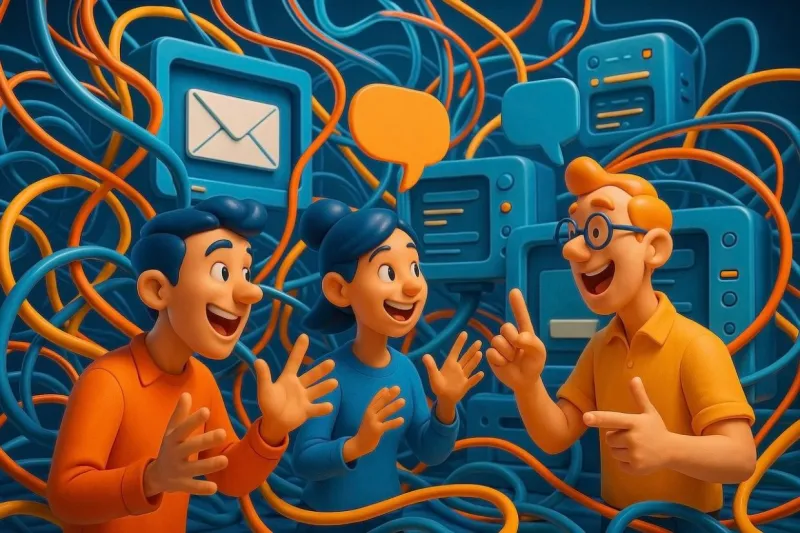
Photo: person leaving social media apps switching to online forum community discussion, via apicms.thestar.com.my
Somewhere between the fifteenth sponsored post and the third "suggested for you" video from an account you've never heard of, something breaks. You open an app to check in with a community you care about and spend forty-five minutes watching content that has nothing to do with why you opened the app in the first place. Then you close it feeling vaguely worse than when you started.
This experience — so universal it barely needs describing — is quietly driving one of the more interesting shifts in how Americans are spending their time online in 2024. Forum communities, once considered relics of the early internet, are not just surviving. In a lot of cases, they're genuinely booming.
The Numbers Don't Lie
It's hard to get clean data on forum traffic because the space is so fragmented — thousands of independent platforms, niche boards, and self-hosted communities that don't report to anyone. But the directional signals are hard to ignore.
Reddit, despite its own complicated relationship with its user base following the 2023 API controversy, still sees over 50 million daily active users in the US alone. Discord servers built around specific interests routinely host communities of tens of thousands. And perhaps most tellingly, a wave of independent forum platforms — including tools built on software like Forumized — have reported significant upticks in new community creation over the past eighteen months.
Meanwhile, Meta's own internal research (made public through various leaks and regulatory filings) has repeatedly flagged declining engagement among younger US users. TikTok continues to dominate attention minutes, but "engagement" and "community" are very different things.
What Social Media Got Wrong
To understand why people are leaving, you have to understand what they were promised versus what they got.
The original pitch of social media was connection — stay in touch with friends, find your people, share what matters to you. For a while, that's roughly what it delivered. Then the ad-driven engagement model took over, and the incentives changed completely.
Algorithms optimized for time-on-platform, which meant prioritizing content that provoked strong emotional reactions — outrage, envy, anxiety. Your feed stopped being a reflection of your interests and became a carefully engineered slot machine designed to keep you pulling the lever. The "community" you thought you were part of got diluted by sponsored content, viral strangers, and engagement-bait posts from accounts you'd never chosen to follow.
Marcus, a 34-year-old software developer in Austin who moderates a forum dedicated to mechanical keyboards, describes the shift plainly: "On Twitter or Instagram, I was always performing for an audience I didn't know. On the forum, I'm actually talking to people who care about the same weird niche stuff I do. There's no algorithm deciding what I see. I just see the conversations that are actually happening."
The Appeal of Small, Focused Spaces
This is the part that surprises people who haven't spent time in active niche forums recently: the quality of conversation is genuinely different.
When a community is built around a specific topic — whether that's sourdough baking, vintage synthesizers, college football recruiting, or urban planning policy — the baseline shared context changes everything. You don't have to explain why you care. You don't have to defend your interest as valid. Everyone in the room already gets it.
This shared context enables a depth of discussion that broad social platforms structurally can't support. A thread on a dedicated woodworking forum might run 200 replies deep, with experienced craftspeople walking a beginner through a specific joinery problem with the kind of patience and detail that would never survive an algorithm-driven feed.
There's also something to be said for the slower pace. Forum conversations don't disappear in 24 hours. A thread posted three years ago might still be getting replies, still ranking in Google searches, still helping someone who just found the community today. That permanence creates value in a way that ephemeral social content simply doesn't.
Privacy Is Part of the Story
It would be incomplete to discuss this migration without acknowledging the growing privacy concerns driving some users away from the major platforms.
Facebook's data practices have been under federal scrutiny for years. TikTok faces ongoing national security debates in Washington. Even platforms with better reputations have faced criticism for the sheer volume of behavioral data they collect and monetize. For a meaningful segment of US internet users — particularly those in their 30s and 40s who remember a pre-surveillance internet — this has become a genuine dealbreaker.
Many independent forum platforms collect dramatically less data by design. They don't have advertising empires to feed. The business model, when there is one, tends to be subscriptions, community fees, or software licensing — not selling your attention to the highest bidder. That's an increasingly compelling proposition.
The Communities Leading the Way
Some of the most interesting stories in this migration are coming from communities that have deliberately chosen independence over scale.
A long-running forum for amateur astronomers in the Pacific Northwest recently migrated off a major social platform entirely, building their own hosted community using dedicated forum software. Membership dropped initially, then stabilized, and the moderators report that the quality and depth of conversation improved dramatically once the casual drive-by traffic fell away.
A true crime discussion community with roots going back to the early 2000s has resisted every wave of platform migration pressure and continues to thrive on its own infrastructure, with members who've been participating for fifteen-plus years. The longevity itself has become a feature — the institutional knowledge embedded in years of archived threads is irreplaceable.
What This Means for the Future
Nobody is predicting the death of Instagram or the collapse of TikTok. Broad social platforms fill real needs and will continue to attract massive audiences. But the emerging picture of online life in 2024 looks less like a few dominant platforms controlling all the conversations and more like a layered ecosystem — big platforms for discovery and entertainment, niche communities for the conversations that actually matter to you.
For the platforms, this is a warning. Users have demonstrated they'll leave when the product stops serving them. For the forums and communities doing this right, it's a genuine opportunity.
And for the millions of people quietly burning out on their feeds, it's a reminder that the internet was always capable of being something better than what it became. The conversations worth having are still out there. Sometimes you just have to look a little harder to find them.
Or, you know — build your own.